
What the f*** is Executive Function?
Rethinking productivity for neurodivergent lives


After I shared the HALTS-UH framework in my last post (the missing manual to your neurodivergent nervous system), I had an interesting question from a client:
“What is actually happening in my brain when I am hungry, tired or hormonal, etc., then suddenly can’t do anything?”.
This is where the framework stops being a self-awareness tool and needs a companion model to explain further. HALTS-UH tells us what state we’re in, but not why. This is where Executive Function comes in.
If you have searched ADHD on any search engine, you are likely to have come across the term Executive Function, but what the f*** is it? The term is often used to refer generally to the management system of the brain, the CEO. But it also refers to specific theories of ADHD developed by two of the dons in the field, Thomas Brown and Russell Barkley.
Executive function is not about intelligence, motivation, willpower, or character. Executive function is about doing the thing. It is the brain-based skills that allow us to plan, initiate, sustain and shift tasks.
For the purposes of this article, I will use Brown’s executive function theory, as it is a fundamental of ADHD coaching. The theory has a cluster of six elements that make up the symptoms that an ADHD-er experiences. Brown suggests that these clusters are dysfunctional in an individual with ADHD. Not a single skill, but a set of interrelated capacities that work together. When one part falters, everything else can wobble.
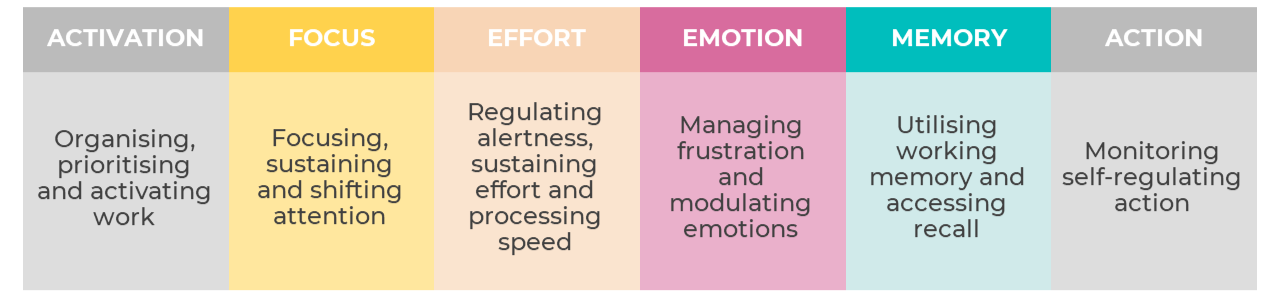
Fig 1. Brown’s Executive Function/Attention Model
HALTS-UH is the early warning system. Brown’s model explains what actually goes offline. One of the biggest shifts Brown’s model invites is this. Executive function is not a character trait; it is a state-dependent capacity.
Clusters explained
Activation
Think task initiation and procrastination, things that are notoriously difficult in ADHD-ers. Although we find activating ourselves tricky, we are also paradoxically great at planning, think lots of lists. It is the actual “doing” that is the issue.
As Barkley once famously said, “ADHD is not a disorder of not knowing what to do, but a disorder of not doing what you know”.
This is frequently where habit recommendation starts too late. If activation is wobbly, no amount of tracking, streaks, or accountability will help.
Helpful hack - Externalise, externalise, externalise. I cannot emphasise this enough. Think lists, whiteboards, Post-it notes, and voice notes. Checkout my post on outsourcing your brain here. Or, why not pair task initiation with a cup of tea or your favourite song.
Focus
The ‘A’ in ADHD, our apparent attention deficit. However, it’s not a deficit, as we can just as easily hyperfocus on something of interest to us. It is more a consistency issue rather than a deficit issue. There are strategies to help with this, but being aware of our capacity (think energy levels) is the most important tip. Having to focus our attention is seriously draining for neurodivergent peeps.
Helpful hack - Work with interest, not against it. Gamify tasks if possible. Julie Parry and Christy Benson have some great ideas on how to do this in their book Tidy-ish.
What would make the task even 5% easier to focus? Could you move to a different room, a different chair or do the task at a different time of day?
Effort
This is where sustaining our attention enters. Particularly difficult when we find a task boring, repetitive or when our reserves are low. Our consistency collapses when we are tired, hungry or hormonal.
This is where productivity culture does the most harm. Effort is not limitless, and for many neurodivergent individuals, it fluctuates massively.
Helpful hack - Have a plan for when you have a low-energy day, not just your ideal day. Try tracking your energy levels throughout the day for a week. Notice any patterns in when you have more or less energy, and then use this new knowledge to your advantage.
Emotion
Believe it or not, emotional regulation is an executive function, despite it not being a diagnostic criterion (as it should be). When we are emotionally dysregulated, we are no longer able to access memory or have the ability to plan.
When this cluster is overloaded, you may feel particularly sensitive and take everything personally. Everything feels urgent and unmanageable.
Helpful hack - Use sensory regulation as emotional regulation. Try a weighted blanket, put on a supersoft item of clothing, take a hot bath or dim the lights.
Memory
When we talk about memory in relation to ADHD, we are not talking about forgetting the name of your first teacher. We are referring to working memory, a limited-capacity system that temporarily holds information to be used in processing tasks.
This is why you walk into a room and have no idea why you are there. It is also why it can sometimes be difficult for reading comprehension, such as when we read a book and have no memory of the last few pages, let alone the last chapter.
Helpful hack - Assume that you are going to forget things and design around it. I use Post-it notes and whiteboards throughout my home.
Action
This cluster entails you actually doing the thing that you have planned to do. Not just starting, but also completing said task. But, it is important to remember that there is no room for perfectionism here; good enough is good enough. It’s better to be 80% completed than 100% uncompleted. Sometimes we get paralysed chasing 100% perfect.
Helpful hack - Define what “done” means before you start the task, then create visible markers of progress.
When you combine HALTS-UH with Brown’s model, the question changes.
Not “Why can’t I do this?” But:
What state am I in?
Which part of my executive system is probably offline?
What would support look like here, not discipline?
Often, support can be food or a nap; sometimes it is merely reducing self-expectation.
This is the reason that typical productivity advice misses: it assumes that capacity and executive function are consistent. For neurodivergent people, they are not.
Understanding your nervous system and executive functioning is not a luxury; it is about being adaptive.
If this resonated, please subscribe. No hustle. No spam. Just two honest pieces a week.
Really clear and useful. Understanding executive function as state-dependent explains a lot. I see this play out constantly with my students as a SLP.
This hit me. Neurodivergent productivity isn’t laziness or discipline, it’s about variable capacity. Food, energy, environment, they aren’t minor hacks, they’re essential scaffolds for getting things done 👍🏽